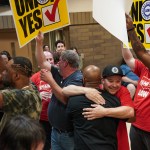
CLASS WAR: "We Ain't Your Human Resource!"
"These firms have to become viable, and that means they have to look at all of their costs and bring them into line so that they can compete in today's global economy because they have come to the taxpayer asking for assistance, and that's the least the taxpayer can ask for in return."
- White House spokesman Tony Fratto as quoted in Washington Post 12/24/08
"And that's the least the taxpayer can ask for in return?" Excuse me? Just who the hell are the taxpayers here?
Corporate lobbyists like to claim that the
What they don't like to discuss, however, is the effective corporate tax rate; the amount these corporations actually PAY in taxes each year. And, once again they are right in avoiding this topic, because to do so would severely undermine their argument that business pays its fair share in taxes in this country when in fact they enjoy considerable corporate welfare.
In November, 2004, McIntyre and Nguyen published their study FREELOADERS: Declining Corporate Tax Payments in the Bush Years. Their findings show a disturbing growth in the corporate welfare state under Bush that has continued unabated to this day. The numbers should be embarrassing to any within this corporate class who claim legitimacy as a taxpayer in light of the enormous profits recorded by the Fortune 500 Companies that were studied.
Meanwhile statistics show that the disparity in incomes between the wealthiest in the business class as compared to the middle class has grown steadily in the last few decades.Over the three-year period, the average effective rate for all 275 companies dropped by a fifth, from 21.4 percent in 2001 to 17.2 percent in 2002-2003.
The statistics are startling:
· Eighty-two of the 275 companies, almost a third of the total, paid zero or less in federal income taxes in at least one year from 2001 to 2003.....
· Twenty-eight corporations enjoyed negative federal income tax rates over the entire 2001-2003 period....
· In 2003 alone, 46 companies paid zero or less in federal income taxes.....
· In 2001, the Treasury paid corporations $40 billion in tax refunds, a third more than the 1998-2000 average.
· Then in 2002 and 2003, after the law was changed to expand tax subsidies and make it easier for corporations to carry back excess tax breaks to earlier years, corporate tax refunds skyrocketed to an average of $63 billion a year -- more than double the 1998-2000 average.
Corporations are now paying the lowest levels of taxes in the post-World War II era. In fiscal 2002 and 2003, federal corporate incomes taxes dropped to their lowest sustained level as a share of the economy since World War II. Only a single year during the early Reagan administration was lower.
Embarrassing? Indeed, unless you have no shame, are overly-impressed with your self-importance, and you are accustomed to having your way via extortion sprinkled heavily with campaign contributions.
How else might the "respectable" Mr. Paulson &
Yet the arrogance and elitism expressed by these "Captains of (the Financial) Industry" and the corporate owners of wealth is not yet fully defined here. No, it is their response to the taxpayers request for assistance in maintaining their own earning potential that sets a new and high standard for just how incredibly arrogant the corporate sector has become, along with their apologists in the political and media arenas.
Having avoided the greater share of their responsibility to pay taxes, these parasitic corporate welfare tagalongs would now propose to tell the taxpayers how their tax dollars should be spent. It was humbling - no, humiliating - to watch as the CEO's of the Big Three Automakers pleaded their case before Congress to receive $17 billion dollars in loans from taxpayers to help our auto industry weather this economic downturn which, by the way, was initially triggered within our financial markets. The amount requested was a mere pittance compared to the monies that were gifted to the financial market itself. And these dollars were expected to bridge a time period within which the auto industry would create a plan that showed how they would survive the economic upheaval we face. This, alone, was different than the Paulson giveaway, which was accomplished without any real explanation of how his $700 billion dollar disbursement might actually serve the interests of anyone beyond the people to whom it was given.
After having stolen theirs, Paulson & his corporate comrades would now insist that "free market capitalism" requires any loans to the manufacturing sector be considered only if the middle class beneficiaries first make concessions to reduce their earning potential. "These firms have to become viable," says the White House, carrying water for these Class Warriors from the winning side "and that means they have to look at all of their costs and bring them into line so that they can compete in today's global economy." How better a way is there to reduce labor costs, they ask, than to use this time of need to extort additional wage concessions from the UAW?
The appropriate answer, from those among the middle class smart enough and strong enough to finally engage the enemy in this Class Warfare which has been visited against us, is to say "Kiss my ass!"
It is past time for the middle class to become smart enough to understand that their earning potential is directly linked to the success of the UAW and other union bargaining efforts. We must be smart enough to understand that a race to the lowest common denominator in wage rates for labor does not serve our interests. We need be smart enough to understand that the "enemy" is not our working brethren, but rather the wealthy class who maintain a strangle hold on labor to gain for themselves every bit of wealth they can grab from this economy.
In standing tall together and repelling this demand that we surrender ground in this economy by agreeing to lower our wage expectations and become "competitive," we can at last let the wealthy corporations and the "ownership" class know that we are not their "human resource." We are not simply another commodity - like steel, or utilities, or raw materials - to be bought cheap, used up, discarded and replaced.
Instead, we must proudly insist that we are owners of this economy with every right to share in its benefits as the wealthy class has done these last number of decades. We are, in fact, the taxpayers who deserve benefit of any taxpayer bailout - whether tendered as a gift or a loan - that may now be offered to soften the blow of this economic downturn. Rather than a "free market," we must instead insist that we engage a "fair market" that recognizes the need to include everyone - poor, wealthy, and in-between - in developing the means by which we will pursue the blessings of liberty and the pursuit of happiness in our economy.
For now, however, the important question to be answered is, unfortunately, "Whose side are you on?" In the end, we must certainly align ourselves with all our brethren - poor, wealthy, and in-between - instead of choosing sides in a counter-productive battle between players in this economy. That is, after all, what democracy is all about. We ultimately need to all roll up our sleeves and work together for the common good in overcoming the many challenges we confront in this economic downturn.
Meanwhile, however, it's important to understand that we have had a Class War imposed upon us by those who hope to beat us into submission. We therefore must now stand tall in defense of ourselves and others in the middle class who have meekly stood for far too long with hat in hand awaiting the largesse of the wealthy corporate class who sold us on "trickle down" economics, and who instead set about robbing us of everything - up to and including our pride - to fatten their own bottom line.
Congress must now do whatever is necessary to address the immediate problems in our economy. In so doing, however, they must refrain from engaging the Class War on behalf of their campign contributors and instead lay the groundwork for a new economy that serves everyone's interests going forward.
******************
NOTE: Read more CLASS WAR essays by scrolling through the posts on SleepinJeezus' blog here.


What is is.
What is not, is not.
And the effective rate is not what is being paid or even close to being paid and the reason for that is a conspiracy. The Reps, and yes, some dems, have conspired with CAPTAINS OF INDUSTRY.
As Miguel says, this is not capitalism, it is organized crime.
Sleepin, this segment of your series points to something that can be changed. By the New Congress and the New WH.
If I remember correctly, you also read one of our brothers demonstrating that Paulson may have actually given 160 billion more to these pigs, in tax relief. Paulson. Not Congress and not even w's WH.
As usual, good post. What I like about the series is that I can go back and read it all.
December 26, 2008 8:46 PM | Reply | Permalink
You and miguel are quite right. This is organized crime, indeed.
It's been remarkable to witness these crimes that occur in broad daylight. As Paulson made his move to heist the $700 billion, for example, my reaction was to say "Hey, that looks a little fishy, but surely he isn't so bold as to use this crisis to accomplish nothing more than fattening the coffers of his associates (and undoubtedly, himself) eh? In this time of crisis, our Secretary of the Treasury certainly couldn't be focused solely upon stealing $700 BILLION from the taxpayers, could he?"
And then after it becomes a fait accompli, it's too late to effectively do anything about it.
Kinda' like how I felt in the run up to the Iraq war. "Naw, they really aren't serious about invading another country on the basis of this shit intelligence and the chickenhawk neocons' perverse thirst for blood, eh? At some point, someone in Congress or in the Press will surely declare that 'This Emperor has no clothes!' and we'll all just get back to business, right?"
OR...
"Naw, Our President would never be tempted - nor would he ever have been allowed - to authorize torture or mistreatment of prisoners such as we saw at Abu Ghraib. That's just a fraternity prank gone awry, right? Surely the President of the United States would never be allowed to violate the principles laid out in our Bill of Rights, let alone violate the Geneva Conventions, right?"
OR...
etc., etc. etc.
It's like sitting at the mad hatters tea party, only with far more serious ramifications.
Thanks for the kind words and the encouragement, Dick. Keep the faith!
December 27, 2008 2:31 PM | Reply | Permalink
This silliness will go on forever until the FAIRTAX is passed.
No corporate welfare, the poor are completely UNtaxed and fairness is throughout. And no IRS to boot.
fairtax.org
December 26, 2008 11:57 PM | Reply | Permalink
The fairtax is unfair. An increased sales tax burdens the poor. The IRS should exist as a regulatory apparatus and needs reform. Capital gains should be increased, Clinton's tax rates should be reinstated, and the burden of taxation should be more equitably distributed.
Abolishing the Fed and its inflation-based phantom tax is also important.
December 27, 2008 11:57 AM | Reply | Permalink
The fair tax, or flat tax, is incredibly regressive, which is why the funding that promotes it comes from some of the wealthiest individuals and corporations who would live as parasites on the backs of society, even more than they do now.
Besides, tax policy is a vital - and I'd say indispensible - tool to be used in crafting policy. For example, a tax on gasoline that establishes a floor at $4/gallon is perhaps the singularly most important step the government could now take if they were truly serious about encouraging growth of a renewable fuels industry.
December 27, 2008 2:05 PM | Reply | Permalink
Your post inspired me to reflect on how we got here, and I just started stringing thoughts together in an effort to clarify some of this in my own mind. Forgive the rambling nature of my comment.
The economic crisis we are suffering today got its first real foothold during the '80s. The deregulation of the Reagan years gave birth the rise of a very short sighted approach to investing. Round One consisted of the arbitragers and their slice and dice approach to squeezing 'value' from their acquisitions to the short term benefit of shareholders and often to the detriment of the acquired company and workers. Then there were the junk bond traders hawking investments soaked in subterfuge and outright fraud. Following that, we passed through the looking glass in the investment world, and value was no longer tied to the bust-up value of a company or a simple price earnings ratio. This phase largely correlated with the advent of significant investment dollars becoming available to Wall Street via the retirement funds/savings accounts of the baby boomers, (those same human resources again!).
The Big Ponzi enters stage left. Value became a subjective thing, more a matter of perception than any rigorous analysis. A lot of others bought into this paradigm besides the financial whiz kids of downtown NYC. Hence the advent of market bubbles, be they dot com, or real estate based. Having the world's monetary units tied to the dollar post 1971, after the flaws in the Bretton Woods summit were revealed, only reinforced American financial captains belief in the indestructibility of the our economy. That belief is in no small part dependent on the world's nations accepting the US as the primary world peacekeeper/protector. Now in the aftermath of Bush 43s presidency and all our mistakes that particular world view of us is more tenuous than at any time since WWII.
As the financial/business world became less and less tied to actual events and realities, those corporate and financial captains truly did start to see the working stiff more and more as a commodity no different than the raw materials used in the manufacture of their products and the advent of 'free trade' allowed them to ship unskilled and semi-skilled labor offshore. We see now that this attitude leads to the destruction of the intended market for their products and services: those same working stiffs and their earning capacity, (ie. you and I and the rest of the people reading this).
One thing is clear to me, and that is that business will always act in its own self interest, and that self interest is inherently shortsighted. The only way we will ever have responsible business for the nation as a whole, is by overseeing the overall system and implementing policy that will result in a large, prosperous, and economically secure middle class. Thanks for letting me ramble. Rec'd.
December 27, 2008 2:14 AM | Reply | Permalink
Hey, Miguel if you and Sleepin and Pseudo did not ramble, I would have little to read.
"As the financial/business world became less and less tied to actual events and realities, those corporate and financial captains truly did start to see the....."
I have been quoting you all week--THIS IS NOT CAPITALISM, THIS IS ORGANIZED CRIME.
December 27, 2008 2:35 AM | Reply | Permalink
One rambler to another...
I really appreciate the thoughts you have laid out here, Miguel, and am particularly concerned that business interests are inherently shortsighted, as you point out.
I'm somewhat curious to learn from someone more schooled in economics than I what the impact might be of the incredible growth of mutual funds, 401k's, and such as we've seen these last number of decades.
I begin with an understanding that the purchase of stock in a company is an assumption of ownership of that company. Most advisors I have ever known have cautioned that an investor should be in for the long haul and should thoroughly understand any company they consider investing in.
Such investors are prepared to support the long term interests of the companies they "own." If major capital improvements are required this year, for example, to promote the long term health of the business, so be it, even if it results in lower dividends for the immediate future.
My concern lies in the fact that mutual funds essentially remove the investor from this ownership role. I may own stock in a hundred different companies through my mutual fund without even knowing which companies I "own."
For the mutual fund manager, his role becomes different than the aforementioned "ownership" of companies. Instead, it would seem that the objective for the fund manager is to churn profit (hopefully!) as a glorified day trader. Hence, companies become more concerned about the next quarter's financial report rather than the long term needs of the company as a means to best attract these mutual fund investors and keep their stock value high.
"What have you done for me lately?" would seem to be the operative question driving much of the market. Am I wrong in this assumption? Is this as unsustainable as I imagine for the long-term health of our markets? Is this more casino than rational investing? Is this anyway to run a railroad?
I'd be curious to gain a response from you or from others who possess more expertise than I.
December 27, 2008 7:46 AM | Reply | Permalink
First a disclaimer: I'm not an economist, or even that knowledgeable of the financial community. Having said that, I think your assumptions on the effect of the growth of mutual funds and the dissociation of those fund holders from the 'ownership' of the companies the funds are invested in are basically correct. The process does move the fund managers into that 'ownership' role by proxy. This has allowed the big fund managers to have access to tremendous wealth to 'play' with and consequently 'power' on Wall St. In the process the investment community becomes even more of an insiders scene than ever, with the big players working out deals based as much on their shared background and networking, as on rigorous portfolio analysis. Here's where we drop through the looking glass of 'perceived value' vs. actual value.
'Long-haul' investors are still out there, but the last thirty years have seen incredible fortunes amassed by short haul buyers. Those success stories have inspired a lot of people and fund managers to pursue the short term gains in lieu of a more conservative investment strategy. Interestingly, the returns on the short term investments on average doesn't compare that favorably to a long investment over the same period of time when factoring in risk.
The upshot of these aspects of our current investing paradigm is not only the effect on the long term sustainability of those markets, but it hampers any long term strategic goals from being realized by individual corporations, or perhaps more importantly by our society. We try to account for this through fiscal policy, as Obama has pledged to do regarding funding for alternative energy, but without that immediate fiscal stimulus, most corporations are hesitant to undertake the capital intensive research required unless profitability in marketing the same is all but guaranteed. By then is it or will it be too late? The investment climate of the recent past has ensured that Bell Labs/Lucent ain't what it used to be. This leads back to my point above that without effective financial regulatory oversight and implementing policy to realize societal goals, we will always be on the wrong side of the bell curve in addressing the technological and societal problems we face, as business always has and always will have its own goals first and foremost.
December 27, 2008 3:38 PM | Reply | Permalink
Thanks for the great reply, miguel. You've answered my questions and habve shown that "ownership by proxy" is even more insidious than I thought.
December 28, 2008 3:46 PM | Reply | Permalink
I think those two ramble a lot less than I do, DD, but glad you find some value, (perceived or otherwise), in my thoughts.
December 27, 2008 2:44 AM | Reply | Permalink
The crux of the problem is twofold. First, asset value has been transformed into speculative value based on an asset's projected performance. 401ks offer a steady pool of income that allows the speculation to exist. So you have a real world that is increasingly metaphysical and subservient to the shadow world of fortune telling. Historically, it can be compared to a sport becoming dependent on gambling. The ethos of the sport becomes a front for crime.
In this climate, fights are fixed. Tipsters sell "sure things" in the form of AAA bonded credit default swaps whose core value depends on risky adjustable rate loans that are in reality time bombs set to explode at specific times. Payments are made for 18 months before the interest rate detonates and the AAA investments turns toxic. The "sure thing" comes up lame, and the fixers demand payment. In this case, however, the fixers are subsidized by taxpayers because their "inside man" is Henry Paulson.
Look around: Goldman Sachs loses almost all competition, and is now a commercial bank that can soak up all those foreclosed properties. So can Chase, which obtained land assets for a mint. And taxpayers underwrote the scheme.
Killing organized labor is a bonus.
We've been swindled.
December 27, 2008 11:06 AM | Reply | Permalink
"We must be smart enough to understand that a race to the lowest common denominator in wage rates for labor does not serve our interests."
Sleepin', this is a key point. We need to decide how much the "average" American ought to be making, what the minimum wage ought to be, and then peg everything from that.
The time has come to disabuse ourselves of the notion that the US standard of living is determined by forces beyond our control. We can choose the kind of country we live in, and given the choice between Sweden and Argentina (or Thailand) I'd pick Sweden, socialist tendencies and all.
If we let "conservatives" and corporations set the minimum, we're in trouble, not only because our standard of living will fall as other nations come online, but because corporatism unchecked actually destroys the consumers that drive it.
If this point has already been made, sorry to repeat it--I didn't have time to read all comments.
December 27, 2008 12:50 PM | Reply | Permalink
erica, I agree with the principle you lay out here about equalizing the standard of living to a degree less extreme than the spread we now have between the wealthy and the rest of us.
I don't believe that the answer, however, lies with government setting the wage rates. Instead, government's role begins with a recognition that the worker owns his own labor, rather than considering it a simple commodity to be purchased and consumed at the cheapest cost available by the "ownership class."
The government should once again take the role of referee in collective bargaining, re-establishing and enforcing the pre-Reagan laws, rules, and regulations that equalized the power exercised by the two sides at the bargaining table. There is a fundamental fairness to be realized when the two sides - management & labor - sit at a table and hammer out a contract. Ultimately, both sides have a vested interest in the viability of the company. Neither side can be expected to take a hard-line stand that threatens the welfare of the company itself - unless, of course, the demands of management, for example, are so far out of line that it is no longer worth providing labor for the compensation offered. Alternatively, the company might decide that the demands made by labor in collective bargaining are so punitive that it becomes reasonable to suffer the costs established by law that ultimately afford the employer the possibility of "locking out" an intransigent and unreasonable Union to instead pursue other options to acquire labor.
Perhaps most importantly, fair and equitable binding arbitration is another tool government must provide to settle difficult negotiations.
Like you, erica, my preference would be for the more socialist egalitarianism that countries like Sweden enjoy. For now, however, I would be happy to simply find ourselves back in pre-Reagan times when a worker owned his own labor and had the right to collectively bargain with employers the terms under which that labor would be provided.
**************
ALSO, ON ANOTHER NOTE: Government's role should also involve trade policies that serve everyone's interests. In this, the company that insists they will simply move their manufacturing offshore to avoid negotiating a labor contract in good faith should be encouraged to do so - with stipulation that their goods made offshore will not be welcomed into this market. You want to manufacture your washing machines (or whatever) in Malaysia? No problem. But understand that you will sell those machines to the Malaysians, 'cuz they won't be allowed as imports into this market. "Fair Trade" rather than "Free Trade" must become the standard policy.
Thanks, erica, for your thoughtful response. I may well post these comments - inspired by yours - in a separate post of its own.
December 27, 2008 3:17 PM | Reply | Permalink
Thinking out of the box for a moment........
What if the UAW and other unions reconfigured themselves as National Banks? Would they not be in a position to gain access to the bailout funds just like the non-depository financial companies doing the same?
December 27, 2008 12:54 PM | Reply | Permalink
My suggestion has been that the autoworkers reconfigure themselves into an employee owned company(ies). (see last section in essay)
Imagine what it would do for morale if it was laid at the feet of middle class labor that they are charged - with government assistance a' la' the financial sector - with rescuing our auto industry. Whatever necessary sacrifices there were would be made, but they would be self-directed with a confidence that the ones now making the sacrifices would also reap the benefit of their labors when the economy eventually turns around.
I wish Obama and team would really explore this idea, for I think it could provide substantial change toward saving the economy AND moving toward a more fair and equitable economic system.
December 27, 2008 1:55 PM | Reply | Permalink