The New Senator from NY- Fran Drescher!


I mean, why not?  Really?  I live in Minnesota.  The race does has some influence on me as a citizen of the U.S.  So, I do get an opinion.  Yet, I feel I shouldn't feel too strongly about it since I'm not a constituent of the State. Thus, for me Fran Drescher seems the safe choice.  Upon further examination the strong choice. 

I found a statement I couldn't disagree with on this Reuters blog article on Fran's Senate run by Jill Sergeant.  I understand the arguments against her Hollywood ties.  How do you argue with this?

Do actors make good politicians? I don't think one profession lends itself to the other more so than experience in any other profession save previous political experience. It certainly helps the public identify with them-their names and faces. Like a bonus round of advertisments, their careers can promote them. We as Americans need to stop and weigh what these actors say disciminately and not be clouded by false perceptions. Actors are people-plain and simple. They too have their own opinions and are just as valid as anyone elses but for us to look at Fran Drescher and actually think we are voting in the Nanny is ridiculous. The fact they were acting before their political careers begin should be a moot point. If she thinks she can do the task than more power to her! If my views coincide with hers, I would vote for her but on that basis alone not her acting career.

Other comments like "she's a survivor" also resonate with me.  She's an experienced one of those. Indeed, Fran Drescher's career and experience are not things to be made fun of either.  "More than just a pretty face and a nasal voice" as blogger Jill Serjeant states.  Serjeant continues:

The actress has survived uterine cancer and earlier this year she was appointed to a U.S. State Department envoy program and toured Eastern Europe to talk about health issues. Last year, she created a charity called the Cancer Schmancer Movement after her recent battle with the disease.  Drescher told People magazine that when she was on the lecture circuit for the State Department she was often asked about a future in politics.  "It was one of the single most-asked questions: When are you going to run?  Only second to: Is that your real voice?," Drescher told the celebrity magazine.

She has name recognition.  She's likable.  She's popular.  She's been tactful about throwing in her hat.  She's adamantly pro-gay and pro-woman.  She comes from a working class family.  She's survived rape and cancer; started her own health care movement (albeit a small one).  She's ran her own TV show.  She seems admirable.  Commendable, even.

Another factor is the chaos factor.  Namely, the Senate is such an old, doddering institution I'd like to see some chaos thrown in.  Senator Al Franken will be great and shouldn't be taken likely.  In that same outsider, non-pol background, sort-of sense:  I'd love to see a little Senator Fran Drescher chaos.  The Senate needs a little mixing up.

So for me, the non-New Yorker paying attention to the side show, Senator Fran Drescher sounds pretty good! 


Last Chance: Richardson, not Hillary, for SoS.


Well, I did it.  I interfered. I fired off an email today to the Obama Transition office.  When Hillary was first proposed I was neutral.  I believed Richardson was and is the most qualified.  However, it was "the" Hillary Clinton and I could see why on the surface the choice made sense. Then, after digging further and after further thought, I decided that "no" having Hillary was not a good idea. 

 I then decided to write the Transition office because: 1) In a democracy offering your opinion is never a bad thing.  2) Obama has invited people's opinions and even their dissent. 3) I believe that the thing that will make Obama's presidency truly great will be people offering there opinions and getting truly involved 4) I thought it would make me feel better.

The following is my letter to the Obama transition team:


Dear President Elect Obama and the Transition Team,

I am writing to you to please consider  not  offering the position of Secretary of State to Senator Hillary Clinton.  I have several reasons for this.  However, for me it comes down to two issues.  One, Hillary Clinton has a disasterous record of ignoring her constituents in New York on human rights issues.  In particular, she has been particularily neglectful of Latin American issues.  I firmly believe that as our national economic crisis continues that our neighbors in Latin America and throughout this hemisphere will be key players in diplomacy, trade, economics, and energy.  I believe with further diplomatic relations with these countries we can find a mutually beneficial relationship with our closest neighbors.  As energy and cost become one,  having good relations with those closest to us will be tantamount.  Senator Clinton has shown little interest or concern in Latin America through her early sponsorship of NAFTA and the like.  The human rights issues she has ignored in Latin America, as well as the constiutuents who have been ignored who tried to bring it to her attention, are even more distressing. 

Second, I believe Senator Clinton's hawkish rhetoric on the primary campaign trail this year has damaged her, and the U.S.'s, standing in the world.  Her comment that we would "obliterate Iran" if Israel was attacked was particularily distressing for me as an American.  I can only guess at how much that statement has already damaged her standing in Iran and throughout the Middle East and Europe. 

I would like to conclude by stating that I voted for Hillary Clinton in Minnesota's caucus on Super Tuesday.  I admire her skills as a poltician.  I particularily liked her stances on universal healthcare on the trail.  Indeed, it was the issue of healthcare that won my intial vote in the caucus.  However, I do no believe she has shown the necessary extensive travels or worldwide reputation as a negotiator and diplomat that are necessary for this role.  When her comments about "obliterating Iran" where made I was embarrassed I had ever caucused for her.

Please consider my arguments.  I would also ask you to please take a hard look at Governor Bill Richardson's record.  I believe with my entire rational mind that he is the person best qualified for Secretary of State.  While George W. Bush was the chief executive in a government controlled by Republicans it was Governor Bill Richardson that negotiated a cease-fire in Darfur, while the rest of the U.S. largely ignored the horrific genocide occuring there.  Governor Bill Richardson was the one North Korea turned to for negotiations during this same period.  Richardson's involvement with North Korea bodes well for him at State and for dealing with nuclear threats like Iran and, of course, the continuing threat of North Korea as well.  He has experience.  The international community has already turned to him for negotiations.  Governor Bill Richardson is the diplomat and skilled negotiator we need heading up your administration as Secretary of State.

Let me add that I do not agree with Governor Richardson on several issues, most prominently his stance on NAFTA.  However, it is his enormous gravitas in diplomacy, negotiations, and the fact that during the time when the world's trust in the U.S. had fallen the farthest that the world, turned to one Democrat, Governor Bill Richardson- that I feel so strongly that he would make a great Secretary of State in the Obama Administration.  I also believe that coming from a border state with Mexico, that he will have some great ideas in negotiating immigration, human rights, and other issues with that country and Latin America as a whole.  Ambitious ideas such as allowing a Latin American country a vote in the National Security Council were announced during his run for President in 2008. 

Also, he has been in favor of negotiating with our enemies.  A platform of your campaign as well.  I do not find that same assurance from the campaign of Hillary Clinton this year, rather she was one of your biggest oponents when it came to dealing with negotiations and pre-conditions.  Particularily, encouraging was Richardson's willingness to have talks with Cuba.  Yet another example of where you, President Elect Obama, and Richardson meet on your foreign policy vision for this country.

I hope you will consider my two cents worth.  Do know that I have enormous confidence in the leadership that I believe you will offer this nation in our troubled times.  I believe, ultimately, you will make the best decisions when you have heard America's voice.  Thus, while it may be a small, singular voice, I offer mine to you today.


Conyers, Feingold, Kemp: Restoring A Felon's Right to Vote.


I am excited to share that legislation was recently introduced to restore a felon's right to vote after they have served their sentence in a correctional institution.  The issue is an important one that could restore voting rights to 5.3 million voters, though sadly not in time for this years election.  Effectively, the legislation would end the civil death experienced by millions of rehabilitated felons after they have paid their debt to society for the crimes they have committed.  Felons on parole and probation would also have their voting rights restored.

The Democracy Restoration Act was recently introduced by Senator Russ Feingold-WI, member of the Senate Judiciary Committee, as well as Representative John Conyers and Chairman of the House Judiciary Committee.  Feingold's statement on the bill can be found here.

In his released statement Feingold accredits the Brennan Center for Justice at NYU and the Sentencing Project for their research on the effects this legislation will have:

According to the Brennan Center for Justice at New York University and the Sentencing Project, 5.3 million American citizens are not allowed to vote because of a felony conviction. Nearly four million people who are disenfranchised are no longer, or never were, in prison, and approximately two million have completed their entire sentence, including probation and parole. Right now, a felony conviction can result in permanent disenfranchisement in ten states. In 35 other states, convicted offenders cannot vote while on parole and in 30 of those 35, people on probation are disenfranchised as well.

The legislation proposed by Feingold and Conyers  has found bi-partisan support in the form of Jack Kemp, former Republican Presidential and Vice Presidential candidate, Congressman,  and Bush 1 Housing Secretary.  In an op-ed Feingold and Kemp point out that the law restores the right to vote to citizens much like ourselves who work hard and obey the law.  Their debt to society has been fulfilled.

For a nation that depends on the participation of its citizens, it is fundamentally un-American to deny the vote to people who are living and working as law-abiding citizens. Furthermore, the more doors we close on people trying to rejoin society, the more likely it is we will drive them back to the behaviors we want them to leave behind.

The disenfranchisement has the greatest effect on African-American men.  Kemp and Feingold continue with statistics from the Brennan Center,

Nationwide, 13 percent of all African-American men are disenfranchised; in some states, it is almost 25 percent. Like the poll tax and the grandfather clause, civil death was a tool of Jim Crow.

"Civil death" is not a term to toss around lightly.  Yet given that many are not allowed to vote for life, such as in Virginia, how can it be called otherwise?  Even those not given a life sentence of being denied a fundamental right are stillfaced with being civilly "suspended" for months, years, and decades, if not their lifetime, while waiting for this basic right to be restored.  In a strong democracy unafraid of the voices of it's citizenry no one should have to feel as though they are "dead" as a citizen.  No fundamental rights should be denied after a debt to society has been paid.  How could one ever hope for true rehabilitation if the opposite is true?

Perhaps, Feingold stated it best in his floor statement,

The rest of us should be ashamed, and yes, outraged. If we believe in redemption, we should be outraged. Because civil death has denied four million Americans a chance at redemption. If we believe in progress, we should be outraged. Because civil death keeps this country chained to the worst moments of our past. If we believe in democracy, we should be outraged. Because civil death strikes at the heart of our democracy.

Erika Wood goes into some details of the effects on this civil death and its history on elections in her article here.  

The continuing laws reflect a past stretching back to our countries worst and to Jim Crow.  Jim Crow being a response to the end of slavery.  Wood likens it to other laws passed in that time, legal barriers placed to continue treatment of African-Americans as second-class citizens.  The laws date to the late 1800s in response to Reconstruction.  The right to vote being suspended or voided for convicted felons being the tip of the iceberg.

The legal barriers employed -- including literacy tests, residency requirements, grandfather clauses, and poll taxes -- while race-neutral on their face, were intentional barriers to African-American voting.

Racism has no place in America.  Jim Crow no longer has a place in America.  These policies left over from a stained past must be confined to just that- the past and kept there. Jim Crow has no place in the future of America.   To deny that these laws are not effecting the present is also naive.

Wood touches the surface in her piece on the effect voter disenfranchisement has on minority communities to this day.  As she states in her piece,

In the last 25 years, as incarceration rates skyrocketed and African-Americans were sent to prison at a rate seven times that of whites, the political power of minority communities has been decimated. It's a simple equation: communities with high rates of people with felony convictions have fewer votes to cast.

The problem effects not just the ex-felon, but their family, their children, their neighborhood, and their community.  

For more information I would strongly recommend checking out the Brennan Center's website on the Democracy Act here.

In conclusion.  I leave you with some closing thoughts on this legislation from Senator Feingold's floor statement.  Feingold's appeals are Constitutional and go to the core of what makes us American:

This country was founded on the idea that a just government derives its power from the consent of the governed, a principle codified in the very first words of our Constitution: "We the People of the United States." From the Civil War through the women's suffrage movement through the Voting Rights Act of 1965 through the 26th Amendment, the continuing expansion of the franchise, a broadening of who "we the people" are, is one of our great American stories.

Do we not want the best for our fellow citizens?  Do we not want to give even those who have fallen the farthest the chance to get back up, to give them a voice and an equal say in our future?   As Feingold states,

If our country wants ex-offenders to succeed at becoming better citizens, who both abide by the law and act as responsible individuals, then we need to restore this most fundamental right. I urge my colleagues to support this important legislation.

I urge you to contact your representatives now and make sure they support this legislation as well.

Extra, Extra! Get your Alternative Bailout Plans!!!


Please feel free to add to the list of alternative plans in the comments section.  Also, please make it  known what you believe is the best potential solution or slowdown for the financial and credit crisis we face.  Thank you.

House Progressive Caucus
-

1. ....we support the enactment of a financial transaction tax equal to one quarter of one percent (0.25 of 1%) on all U.S. stock trades and more exotic transactions such as credit default swaps, options, and futures. This would raise approximately $150 billion/year. In addition, we should amend the tax code to prohibit the tax deductibility of executive compensation in any company where the highest paid corporate officer exceeds the compensation ofany employee by a ratio of greater than 25: 1.
2. ...the federal government and U.S. taxpayers, by extension, must be provided equity shares in any ofthe companies and financial institutions that benefit from the proposed bailout.
3. ...major bankruptcy reform must be included. As this bailout plan is implemented, assets are evaluated, and the financial sector rebounds, top priority must be given responsibly to helping current homeowners renegotiate their mortgages on manageable terms.
4. it is also very important that the financial bailout legislation under development safeguard consumer rights, provide tough, independent oversight, and establish a transparent, effective, 21 st century regulatory regime for the financial industry in America that will prevent any future repetition ofthe current Wall Street calamity.
 

Thom Hartmann:
"Create an agency to fund the bailout, loan that agency the money from the Treasury, and then have that agency tax Wall Street to pay us (the Treasury) back. It's been done before, and has several benefits. In the United Kingdom, for example, whenever you buy or sell a share of stock (or a credit swap or a derivative, or any other activity of that sort) you pay a small tax on the transaction.

We did the same thing here in the US from 1914 to 1966 (and, before that, we did it to finance the Spanish American War and the Civil War). For us, this Securities Turnover Excise Tax (STET) was a revenue source. For example, if we were to instate a .25 percent STET (tax) on every stock, swap, derivative, or other trade today, it would produce -- in its first year -- around $150 billion in revenue. Wall Street would be generating the money to fund its own bailout."

He also goes into some detail on how bailouts, historically, have not worked.


Luigi Zingales:

"Since we do not have time for a Chapter 11 and we do not want to bail out all the creditors, the lesser evil is to do what judges do in contentious and overextended bankruptcy processes: to cram down a restructuring plan on creditors, where part of the debt is forgiven in exchange for some equity or some warrants. And there is a precedent for such a bold move. During the Great Depression, many debt contracts were indexed to gold. So when the dollar convertibility into gold was suspended, the value of that debt soared, threatening the survival of many institutions. The Roosevelt Administration declared the clause invalid, de facto forcing debt forgiveness. Furthermore, the Supreme Court maintained this decision. My colleague and current Fed Governor Randall Koszner studied this episode and showed that not only stock prices, but bond prices as well, soared after the Supreme Court upheld the decision. How is that possible? As corporate finance experts have been saying for the last thirty years, there are real costs from having too much debt and too little equity in the capital structure, and a reduction in the face value of debt can benefit not only the equityholders, but also the debtholders."

John P. Hussman, Ph.D:

1.Public funds must function to increase the capital of distressed financial companies, not simply to take bad assets off of the balance sheet at market value (which may improve the "quality" of the balance sheet, but does nothing to improve the capital cushion and therefore little to avoid future runs on the institution).
2) In return for these funds, the government should NOT take equity (which is a subordinate claim and also creates potential conflicts of interest), but instead should take a SENIOR claim that precedes not only the stockholders but also the senior bondholders in the event the company defaults anyway. Congress may need to make some modification to existing bankruptcy law or provide for expedited bondholder approval to do this, but essentially, the government's claim should be subordinate only to customers in the event of default, and senior to both stockholders and bondholders. However, it should also be countable as capital for the purposes of satisfying bank capital requirements.
3) Ideally, the rate of interest on such funds should be relatively high (which will encourage these firms to substitute private financing as soon as possible), but actual payment should be made once the firms are again profitable so that the payment burden does not weaken them during the present recession.
4) The bill should allow for expedited bankruptcy resolution for these institutions, so that in the event of failure, the "good" bank (all assets and customer liabilities, but excluding debt to bondholders) can be cut away and liquidated to an acquirer as a "whole bank" sale. For nearly all of these institutions, the debt to bondholders is far more than sufficient to absorb any losses even in the event of bankruptcy. The current difficulty is that the bankruptcy process itself draws out the process of taking receivership, cutting away the good bank so that it can be sold to an acquirer, and delivering the proceeds as a residual to bondholders. Streamlining that process is one of the best ways to ensure that the failure of one institution does not have "systemic" effects.
5) To assist homeowners, the bill should allow for a reduction of mortgage principal during foreclosure, but the mortgage lender should also receive a Property Appreciation Right (PAR) that gives the original lender a claim on future property appreciation up to that original mortgage amount. In other words, the homeowner receives a substantially lower mortgage balance and payment burden now, but the lender stands to be made whole over time through property appreciation rather than immediate burdens on the homeowner to make payments.


Overviews of Bill King, Bebchuk, and Roubini can be found here.

James K. Galbraith:

http://www.washingtonpost.com/wp-dyn/content/article/2008/09/24/AR2008092403033.html

"...why not eliminate the pointless $100,000 cap on federal deposit insurance and go take inventory? If a bank is solvent, money market funds would flow in, eliminating the need to insure those separately. If it isn't, the FDIC has the bridge bank facility to take care of that.

Next, put half a trillion dollars into the Federal Deposit Insurance Corp. fund -- a cosmetic gesture -- and as much money into that agency and the FBI as is needed for examiners, auditors and investigators. Keep $200 billion or more in reserve, so the Treasury can recapitalize banks by buying preferred shares if necessary -- as Warren Buffett did this week with Goldman Sachs. Review the situation in three months, when Congress comes back. Hedge funds should be left on their own. You can't save everyone, and those investors aren't poor.

.....Reenact Richard Nixon's great idea: federal revenue sharing. States and localities should get the funds to plug their revenue gaps and maintain real public spending, per capita, for the next three to five years.

....Also, enact the National Infrastructure Bank, making bond revenue available in a revolving fund for capital improvements. There is work to do. There are people to do it. Bring them together. What could be easier or more sensible?

 ....If you need a revenue source, impose a turnover tax on stocks."

Senator Bernie Saunders

1.  Ensure that middle income and working families are not the ones who are paying for this bailout by Imposing a five-year, 10 percent surtax on income over $1 million a year for couples and over $500,000 for single taxpayers. That would raise more than $300 billion in revenue over five years; Ensuring that assets purchased from banks are realistically discounted so companies are not rewarded for their risky behavior and taxpayers can recover the amount they paid for them; and Requiring that taxpayers receive equity stakes in the bailed-out companies so that the taxpayers’ assumption of risk is rewarded when companies’ stock goes up. Taken together these three provisions will substantially reduce the likelihood that this bailout will end up on the backs of average American taxpayers. I

2.Include a major economic recovery package which puts Americans to work at decent wages. Among many other areas, we can create millions of jobs rebuilding our crumbling infrastructure and moving our country from fossil fuels to energy efficiency and sustainable energy. Further, we must protect our must vulnerable families from the very difficult times they are experiencing.

3. Repeal the disastrous de-regulatory legislation that facilitated this crisis.

4.End the danger posed by companies that are “too big too fail,” that is, companies whose failure would cause systemic harm to the U.S. economy. If a company is too big to fail, it is too big to exist. We need to determine which companies fall in this category and then break them up

Joseph E. Stiglitz:

"There are alternatives. Warren Buffet showed the way, in providing equity to Goldman Sachs. The Scandinavian countries showed the way, almost two decades ago. By issuing preferred shares with warrants (options), one reduces the public's downside risk and insures that they participate in some of the upside potential. This approach is not only proven, it provides both incentives and wherewithal to resume lending. It furthermore avoids the hopeless task of trying to value millions of complex mortgages and even more complex products in which they are embedded, and it deals with the "lemons" problem--the government getting stuck with the worst or most overpriced assets. Finally, we need to impose a special financial sector tax to pay for the bailouts conducted so far. We also need to create a reserve fund so that poor taxpayers won't have to be called upon again to finance Wall Street's foolishness."


Thomas Ferguson & Robert Johnson


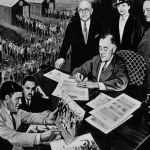
"You could simply take a leaf from the New Deal and do a bank holiday. That is, send bank examiners into all the institutions-- investment houses, and insurance companies and the other major players, as well as banks--to assess them. Insolvent ones are simply closed; everyone knows then that those that survive are solvent. Economic life restarts. The total cost is minimal.

...The government could inject capital directly into financial institutions with a reasonable prospect of survival in the long run. This was the essence of Senator Schumer's proposal that surfaced just ahead of Paulson's announcement and that triggered the rally in world financial markets. The New Deal did this, too. It used the Reconstruction Finance Corporation, which put severe terms on the banks receiving the aid. Wall Street, of course, would love the money, but not the terms.

...There is absolutely no reason why some of the gains accruing both to private investors in the companies directly being bailed out and the broader market cannot be recaptured for taxpayers whose money makes it all possible.

...It also makes sense to insist that firms receiving aid issue senior debt to the government with rights over all other bonds, etc., they have outstanding. That's to make sure some money comes back right from the start and that managements cannot keep all the earnings for themselves by reducing accounting profits and paying themselves more.
...To recapture some of the broader market gains flowing from the injection of public money, one could place a modest new tax on interest, dividends, capital gains.

...And finally, obviously, it is necessary to re-regulate."


Senator Chuck Schumer:


Schumer suggested that fees levied upon all financial market players of sufficient size--regardless of their participation in the rescue program--could be used to bankroll an account akin to the FDIC’s deposit insurance fund. Schumer said he would consider pushing such a proposal this week as Congress continues to consider emergency legislation proposed by Paulson.

“One of the things I've thought about is whether we shouldn't create an insurance fund similar to the FDIC for the whole financial system,” Schumer said at the hearing. “All firms over a certain size would pay, not small little community banks, but everything else. They would pay a fee, not too onerous or too large, but over time it could help to fray the cost of any losses that we might suffer.”

“It's the financial system that has the trouble and the taxpayers are bailing it out, as you say, in part because it will help the taxpayers. But why do the taxpayers have to do the whole thing?” Schumer asked.

In response, Paulson indicated he was indeed thinking of ways the private sector could be tapped to defray the costs of the current proposed rescue, as well as future ones. "One way, as you mentioned, would be some kind of broader, industry-wide tax," Paulson said to Schumer.

Schumer also asked Chairman Bernanke whether he would be open to creating such a fund, and received a positive response. "Potentially, yes," Bernanke said.

Feingold Defends Obama, Praises Biden Pick


From the Wall Street Journal's Nick Timiraos:


John McCain is quick to tout his credentials as a party “maverick” as an advantage over Barack Obama, who Republicans have criticized for refusing to break with his party on any major achievements.

One of McCain’s biggest across-the-aisle partners, Wisconsin Sen. Russ Feingold, defended Obama against those criticisms Sunday, even as he refrained from any criticism of McCain, who co-authored their landmark campaign finance reform bill.

“Both candidates have a record of working with the other side … but I think Sen. Obama is more likely to lead us in the right direction,” Feingold said after introducing the Democratic nominee at a Wisconsin picnic on Sunday. “It’s interesting, I’m maybe the member of Congress who has worked most closely with both of them.”

Feingold cited Obama’s work on nuclear non-proliferation with Russia with Indiana Republican Richard Lugar and their work together on a lobbying and ethics reform bill. “That was a very tough deal where many members of the Democratic Party were pushing very hard on him personally to weaken our bill,” he said.

The Wisconsin senator wouldn’t criticize McCain. “We need to be positive,” he said, and he dismissed Democratic attacks against McCain’s inability during an interview last week to say how many houses he owned. “I don’t believe it will” matter, he said. “People in the end will vote on the issues of working families.”

Feingold, who Obama praised as a man with “the courage of his convictions,” also sounded a call for genuine bipartisanship, particularly if Democrats control the White House and both chambers of Congress next year. “The worst mistake we could make is to not include Republicans whenever we can,” he said. “That’s the formula for disaster.”


From the Milwaukee Journal Sentinel's Patrick Marley:


Pawlenty called Biden a creature of Washington, noting he’s been in the Senate since Obama was about 12.

“Where’s the change?” Pawlenty said. “Barack Obama is all for change unless or until it’s politically expedient to pick the consummate insider.”

Pawlenty noted that Biden had criticized Obama as not being ready for the job when Biden also was seeking the Democratic presidential nomination in the Iowa caucuses. He said picking Biden wouldn’t be enough to boost the ticket’s credentials.

“When you’re going to be president of the United States, it’s not a situation where you should have to have a mentor or a trainer or a supervisor,” Pawlenty said

Feingold dismissed that, saying Obama made a wise decision by choosing someone who could work with him as an adviser and partner. He dismissed the claim that Biden is a Beltway insider, noting that he takes the train home every night so he can be with his family.

“He’s a real guy,” Feingold said. “He’s not some guy who lives and breathes Washington.”


From the Milwaukee Journal Sentinel's Craig Gilbert:


Wisconsin Democrat Russ Feingold, who serves on two Senate committees with Delaware's Joe Biden, praised Biden's selection as Barack Obama's running mate today.

"I think it's a good balance," Feingold said in an interview today, referring to Biden's  longevity and foreign policy experience and Obama's "fresh approach to politics."

Feingold sits on both the judiciary and foreign relations committees, as does Biden. Biden chairs foreign relations, and chaired judiciary before Feingold entered the Senate in 1993.

Feingold said choosing someone of Biden's experience was an important signal for Obama to send.

"I think Sen. Obama wants to make the American people confident that he will have around him people that will make sure he knows and has access to all the information (he needs). He's trying to say, 'This is symbolic of the kind of people who are going to govern with me.' It's probably the most important message for him, and I've felt that way for a long time," said Feingold.

 More on Obama's Eau Claire, WI stop here and here.


Former OMB Director and Rep. Rob Portman (OH)- McCain's VP?


    Apparently, Senator McCain will be unleashing his VP in Dayton, OH this coming Friday after the Democratic Convention.  Of course, he will also be celebrating his birthday that day as well.
    Given the location of the event and McCain's need to shore up his economic gravitas, I believe, McCain will chose former Rep. Rob Portman of OH to be his running mate.  Portman has the following economic expertise working in his favor (from Wiki):
Portman was a member of the Ways and Means Committee and vice chair of the Budget Committee.... Most recently, he was Director of the Office of Management and Budget (OMB). Prior to this appointment, Portman was the United States Trade Representative, a post carrying the rank of Ambassador
I believe this experience coupled with an ability to explain trade and tax policy to an Ohio voter (and voters at large) will seal the deal for him to take the spot as Republican VP.

Second, Portman is suggested by some (Novak) to be Bush's hand-picked choice for McCain's running mate.  True, McCain could want to get as far from Bush as possible.  However, I would add, why start now?  According to the Wiki article:

Very close to President George W. Bush, he acted as the liaison between Congressional Republicans and the White House during the first four years of the Bush administration. In nominating him for the trade post, President Bush called Portman "a good friend, a decent man, and a skilled negotiator."....Later, a public, ceremonial swearing-in was performed by then-White House Chief of Staff Andrew Card on May 17, 2005, with his friend President Bush in attendance. On April 18, 2006 President Bush nominated him to fill the role of Budget Director; its former director, Joshua B. Bolten was promoted to White House Chief of Staff.
Furthermore, Portman was popular when he was a Representative in Ohio, easily winning re-election several times and by large margins. 

Portman was also known as a congressman who reached across the aisle, another key in McCain's branding this election season.  He was best known for legislation on the IRS, eliminating capital gains taxes, environmental protection for trees, and easing ex-cons adaption back to society, and curbing unfunded mandates.  I think many of those issues will align very well with McCain's supposed maverick status while also catering to the GOP base.

In conclusion, perhaps Portman's hometown paper described him best as having "two personas: the well-connected Congressman who would surface on cable news channels as a 'talking head' for the Bush led agenda and another as the politician who drove himself from one small town pancake breakfast or Kiwanis luncheon to another in a district stretching 100 miles plus."


I would also look at this Newsweek blog on Portman, some great info here.  Newsweek agrees he is a strong contender:

 ...he'd probably do more to help the senator be effective once he reaches the White House than any other VP contender.......a perfect economic mouthpiece for McCain, who's notoriously weak on what's become the top voter concern of 2008. But it's Portman's nuts-and-bolts understanding of how the executive branch works--especially with Congress on money issues--that should appeal to McCain. Portman was the first President Bush's liaison to Capitol Hill, whereworked to restructure the IRS and ran the Administration's efforts to pass a controversial unfunded mandates measure; since then, he's helped the second President Bush expand free-trade agreements and structure the federal budget. "Rob understands government to a degree and at a level that most people don't achieve without serving as vice president or president," Robert Paduchik, Bush's campaign manager in Ohio in 2004, told Salon. That's exactly the kind of sidekick McCain--a lifetime legislator mostly interested in foreign policy--will need if and when he moves into the White House. None of Portman's fellow VP possibilities have comparable credentials.


Director Rob Portman (OH)- McCain's VP?


    Apparently, Senator McCain will be unleashing his VP in Dayton, OH this coming Friday after the Democratic Convention.  Of course, he will also be celebrating his birthday that day as well.
    Given the location of the event and McCain's need to shore up his economic gravitas, I believe, McCain will chose former Rep. Rob Portman of OH to be his running mate.  Portman has the following economic expertise working in his favor (from Wiki):
Portman was a member of the Ways and Means Committee and vice chair of the Budget Committee.... Most recently, he was Director of the Office of Management and Budget (OMB). Prior to this appointment, Portman was the United States Trade Representative, a post carrying the rank of Ambassador
I believe this experience coupled with an ability to explain trade and tax policy to an Ohio voter (and voters at large) will seal the deal for him to take the spot as Republican VP.

Second, Portman is suggested by some (Novak) to be Bush's hand-picked choice for McCain's running mate.  True, McCain could want to get as far from Bush as possible.  However, I would add, why start now?  According to the Wiki article:

Very close to President George W. Bush, he acted as the liaison between Congressional Republicans and the White House during the first four years of the Bush administration. In nominating him for the trade post, President Bush called Portman "a good friend, a decent man, and a skilled negotiator."....Later, a public, ceremonial swearing-in was performed by then-White House Chief of Staff Andrew Card on May 17, 2005, with his friend President Bush in attendance. On April 18, 2006 President Bush nominated him to fill the role of Budget Director; its former director, Joshua B. Bolten was promoted to White House Chief of Staff.
Furthermore, Portman was popular when he was a Representative in Ohio, easily winning re-election several times and by large margins. 

Portman was also known as a congressman who reached across the aisle, another key in McCain's branding this election season.  He was best known for legislation on the IRS, eliminating capital gains taxes, environmental protection for trees, and easing ex-cons adaption back to society, and curbing unfunded mandates.  I think many of those issues will align very well with McCain's supposed maverick status while also catering to the GOP base.

In conclusion, perhaps Portman's hometown paper described him best as having "two personas: the well-connected Congressman who would surface on cable news channels as a 'talking head' for the Bush led agenda and another as the politician who drove himself from one small town pancake breakfast or Kiwanis luncheon to another in a district stretching 100 miles plus."


I would also look at this Newsweek blog on Portman, some great info here.  Newsweek agrees he is a strong contender:

 ...he'd probably do more to help the senator be effective once he reaches the White House than any other VP contender.......a perfect economic mouthpiece for McCain, who's notoriously weak on what's become the top voter concern of 2008. But it's Portman's nuts-and-bolts understanding of how the executive branch works--especially with Congress on money issues--that should appeal to McCain. Portman was the first President Bush's liaison to Capitol Hill, whereworked to restructure the IRS and ran the Administration's efforts to pass a controversial unfunded mandates measure; since then, he's helped the second President Bush expand free-trade agreements and structure the federal budget. "Rob understands government to a degree and at a level that most people don't achieve without serving as vice president or president," Robert Paduchik, Bush's campaign manager in Ohio in 2004, told Salon. That's exactly the kind of sidekick McCain--a lifetime legislator mostly interested in foreign policy--will need if and when he moves into the White House. None of Portman's fellow VP possibilities have comparable credentials.


Deflated: Feingold Will Not Be VP


Well, The Nation has succeeded in popping my cleverly crafted balloon!  What meanies!  Seriously though, I thought it was a longshot but I am still convinced he would've been a great sleeper/darkhorse pick.  It was fun campaigning for my favorite Senator and tossing a few wrenches into the VP game.  I  will continue to support and campaign for Senator Feingold and the Progressive Patriot Fund whenever possible.  Also, I'm very happy he will remain in the Senate where he's needed the most.  Someone has to be a voice of reason and speak truth to power there.  Also, I'm thrilled he'll continue to guide the Progressive wing of the party into the future and give us not only more Democrats, but better ones.  I'm very happy for all you Wisconsinites, as well.  Here's hoping for President Feingold in 2017!   Here's the article by John Nichols:

Russ Feingold is popular enough with grassroots Democrats to have been boomed as a potential candidate for the party's 2008 nomination.

He has a national reputation for working across lines of party and ideology; in fact, Republican presidential candidate John McCain jokes that supporters of campaign finance reform think that "Feingold" is his last name.

Feingold comes from a battleground state that both the Democrats and Republicans say is critical to their strategies for accumulating the 270 electoral votes needed to secure the presidency.

Because of the bold stands he has taken as a defender of civil liberties, an advocate for the withdrawal of U.S. troops from Iraq and a champion of fair-trade economic policies, he could calm concerns among internet activists and labor stalwarts who have complained about presumptive Democratic nominee Barack Obama's murkiness on those issues.

And he might even help Obama build confidence and support among older Jewish voters -- who have evidenced some skepticism regarding the candidacy of the Illinois senator -- in the swing state of Florida.

Yet, as Feingold is the first to assert, "I'm not considered for vice president by anybody; it's not even a passing thought."

Why doesn't Feingold's name show up on the long short-list, or the even the short long-list, of Obama's potential running mates?

"I'm too hot to handle apparently," says Feingold, laughing at the very notion of an Obama-Feingold ticket.

Playing pundit for a moment, Feingold says, "I'm not the ideal mix for a guy like Obama for a huge variety of reasons… He's a Midwesterner, I'm a Midwesterner. He's a senator, I'm a senator."

But then the senator from Wisconsin gets to the point.

"Obama's looking for someone who would presumably balance the ticket, and I don't think most people would see me as balancing an Obama ticket," he explains.

Don't get Feingold wrong.

He is not one of those who believes it is wise to search for a boring centrist to "balance" Obama's star power and perceived liberalism. Feingold, who established his Progressive Patriots Fund with the express purpose of "promoting a progressive reform agenda" within the party and nationally, says the Democratic presidential candidate would be best-served by a running-mate with a bold values-driven commitment to challenging the caution and compromises of both major parties.

"I would love it," the Wisconsinite says of a vice-presidential selection that tips the ticket in a progressive direction. "But that's not necessarily what (Obama and his aides) are thinking. I think we would all have to agree that hasn't been their direction since the nomination was cinched."

Feingold's not frustrated for himself.

There's no evidence to suggest that he regrets his decision to seek the presidency this year -- or that the fiercely-independent senator would be happy as anyone's "No. 2." But he is uncomfortable watching Obama, who won the Democratic nod by taking bolder stands than Hillary Clinton on a number of foreign and domestic policy issues, now edge toward the ill-defined and uninspired center.

"It is always hard to see a candidate, even though I like him very much, move on certain issues in a direction I'm uncomfortable with," Feingold says. "I hope it's minimized."

Beyond hoping that Obama picks a progressive running-mate, Feingold says he is of the view that the Illinois senator should go for someone with stature rather than a base in a swing state.

Though he once suggested that an Obama-Clinton ticket would be politically muscular -- and thought he has also speculated about the prospect of former Senate Majority Leader George Mitchell as a strong vice presidential prospect -- Feingold's less interested in naming names at this point than in suggesting a standard that the nominee would be wise to apply.

"I still think that his choosing somebody who has a credibility on foreign policy and military issues -- to make sure people are comfortable with the Democrats on that, in light of the instability in the world – is probably the best approach," explains Feingold. "I don't think Obama does well by trying to pick somebody who is going to win a state for him. I can understand McCain doing that – with a (former Massachusetts Governor Mitt) Romney, a (Minnesota Governor Tim) Pawlenty or a (former Pennsylvania Governor Tom) Ridge. I think Obama has a different way of running, and that is a national wave of excitement based on his candidacy and a strong ticket. I wouldn't cherry pick a running mate just to try and carry a state. That's not what he needs."

Scooped: Obama's VP Choice Solved!


Hmmmm.  Well, it seems Obama is putting the press through the ringer on his VP decision.  Recently, there was an excellent post by Al Giordano over at the Field on the subject of the vice presidency.

Essentially, his point in the blog was to point out that Obama is baiting the press, faking them out, saying "PSYCHE!"  The point of the fake-outs:  to keep the story going, to promote other politicians who deserve a spotlight, and to build up the excitement for the inevitable choice.  I would also argue- to throw off the McCain campaign.  Or as Giordano concludes (using basketball terminology as he did throughout this blog post):

I could be wrong (and if I am, there's no shortage of asshats who will shout "Gotcha!" and proclaim it as proof that I'm overrated as a predictor of future events; well, who isn't?), but the hype around Bayh this week feels - to me - like the prelude to something else, to somebody else, as Obama's running mate: a pump fake to put the rival on his heels and set up the real shot, from outside the three point line.

The "pump fake" of Bayh is also echoed by the earlier press frenzy over Kaine, according to Giordano.  Giordano says he has no idea who the choice will be, but maintains they will chose an "outsider" to reinforce Obama's "change" meme.  He says that a non-endorsement of Obama could even be a good thing.  Giordano hints severely at Sebelius or Schweitzer (through reader's comments) getting the nod.  Al Gore is also mentioned by his astute reader's.

I had a different take, the same take I've maintained for quite some time. 

I have thought for over a year now that Senator Russ Feingold will be Obama's VP.

I have thought this ever since the this Democratic Senate Press Conference on January 8, 2007.

I didn't know Obama was going to get the nomination, but I sure thought his was an effort to gain the Democrats and Obama some publicity.

During the press conference Feingold and Obama unveiled Ethics legislation part of which Bush signed into law. The Good Government Act, I believe. The bill put rules on bundlers (bundling being a hot topic now- see Hess Corporation and Harry Sergeant), lobbyists and corporate jets, etc. A minor victory. In any case this gives Obama and Feingold a record of having already changed Washington.

I thought the press conference seemed odd, a bunch of hubaloo for nothing, considering the legislation hadn't even passed yet. Basically, it was a big Democratic preamble for the election, I think. Getting the brand out there with lobbyist reform and cleaning up Washington. (Funny thing is Lieberman was there. If they only new...)  However, the press conference offers great proof, with great photos, that Obama and Feingold have been changing Washington together for some time.   It's a record the press can go back to.  The fact there are great photos to go with it just adds to media saviness of it all. 

Second, Caroline Kennedy is the VP vetter. Russ Feingold, along with John McCain were recipients of the John F. Kennedy Profile in Courage award for their work on McCain-Feingold. Caroline Kennedy was part of that decision and clearly she has a high regard for Feingold. I'm sure he is very much on her radar.

Kennedy could have even been placed on the committee to help legitimize the decision. Obama knowing he wanted Feingold, knowing Kennedy would draw the parallels of Obama, Feingold, and her father.  Just as she had drawn the parallels of her father and Feingold, and her father and Obama previously.

Third, the issues. Feingold has co-sponsored numerous bills that would help Senator Obama. He voted against the war, Patriot Act, FISA (bring in libertarians, independents), immigration bill. He has recently introduced the Use It or Lose It Oil Bill. The list goes on.

Also, Feingold is a great public speaker. He is very intelligent and thoughtful when speaking. He explains complicated issues in a simple, easy to understand manner, as seen here.   However, he speaks his mind and can speak forcefully, but I've never heard a gaffe. He'd be a great outspoken attack dog. Also, he has a plain and folksy delivery and loves to reference Wisconsin.  He travels to each WI county (all 72) at least once a year.

Clearly, he is popular with libertarians and Independents in Wisconsin. (2004 exit poll results here). Oh, and even Republicans admire his tenacity and his principles. Of course, he also reminds them of the McCain-Feingold bill, which they hate McCain for. Also, important is the possibility of campaign finance violations by the McCain campaign gaining tranction in the traditional media.  Feingold would be great to have on hand in that event.  Finally, he managed to grab some Bush voters in the 2004 election (5 to 6%).

He is also a budget hawk, sits on the Select-Intelligence Committee (which is HUGE--privileged information), the Judiciary Comm, Budget Comm, and the Foreign Relations Comm, among others.

The Select Comm. on Intelligence is really a big one. These Senators have had access to some of the knowledge that has been stinking up politics for the last 7 plus years (see FISA, scandals, etc).

Finally, if you want an outsider, you've got one in Feingold.

I admit Schweitzer is a great choice as well for similar reasons.  However, given some of the circumstantial evidence I have noticed over the last year and a half, all seems to point to Feingold.

However, if Giordano and/or my commentary doesn't strike you as accurate, and you prefer the front-runners, you may enjoy this article.

New, Improved: VP Links?


In late 2007 early senior advisors to the Obama Campaign were front and center. Conference calls that included them were common.  As noted in the LA Times:

Almost every campaign tries to set expectations and impressions of itself quietly behind the scenes. A favorite tool is the conference call where a campaign puts its supporters or experts on the line with reporters from around the country.

Today was Barack Obama's turn. On the line was Tom Daschle, former Senate majority leader and National Obama co-chair, Ray Mabus, former Mississippi governor, and Rep. Russ Carnahan of Missouri, historically a bellwether state in presidential elections.

Recently, I have been thinking that Ray Mabus seems to fulfill many requirements I would want of a President, which I believe is the ultimate choice for a VP, after all.  He was an Ambassador to Saudi Arabia, governor of MS, is extremely popular, great on economic issues, and cleaned up the MS government as the State Auditor, as well.  Finally, he reminds me of Bill Clinton, which could help solidify the party.  Finally, a Southern VP just seems to make sense this year on many levels.

Trapper John, a prescient diarist on Daily Kos, seems to think it will be Tom Daschle.  Trapper John also lays down a good rationale why it won't be Tim Kaine, Evan Bayh, Sam Nunn, or Hillary Clinton.  He admits Sebelius is also a solid frontrunner.  I agree.   Here's the article, it's a great read.

Finally, Carnahan is also an interersting thought.  His family name is huge in MO (his father was elected posthumously) and has a short but interesting resume in the House.  As we all know MO is of course, the bell-weather state, a huge swing state.

I was just very intrigued by reading this.  Let me know what you think.  The interesting thing is since all three are already part of the campaign they can be vetted rather inconspicuously.

Additional links:

Former Gov. Ray Mabus (D-MS)
Rep. Russ Carnahan (D-MO)
Former Sen. Tom Daschle (D-SD)


VP Links?


In late 2007 early senior advisors to the Obama Campaign were front and center. Conference calls that included them were common.  As noted in the LA Times:

Almost every campaign tries to set expectations and impressions of itself quietly behind the scenes. A favorite tool is the conference call where a campaign puts its supporters or experts on the line with reporters from around the country.

Today was Barack Obama's turn. On the line was Tom Daschle, former Senate majority leader and National Obama co-chair, Ray Mabus, former Mississippi governor, and Rep. Russ Carnahan of Missouri, historically a bellwether state in presidential elections.

Recently, I have been thinking that Ray Mabus seems to fulfill many requirements I would want of a President, which I believe is the ultimate choice for a VP, after all.  He was an Ambassador to Saudi Arabia, governor of MS, is extremely popular, great on economic issues, and cleaned up the MS government as the State Auditor, as well.  Finally, he reminds me of Bill Clinton, which could help solidify the party.  Finally, a Southern VP just seems to make sense this year on many levels.

Trapper John, a prescient diarist on Daily Kos, seems to think it will be Tom Daschle.  Trapper John also lays down a good rationale why it won't be Tim Kaine, Evan Bayh, Sam Nunn, or Hillary Clinton.  He admits Sebelius is also a solid frontrunner.  I agree.   Here's the article, it's a great read.

http://www.dailykos.com/storyonly/2008/7/30/10502/7248

Finally, Carnahan is also an interersting thought.  His family name is huge in MO (his father was elected posthumously) and has a short but interesting resume in the House.  As we all know MO is of course, the bell-weather state, a huge swing state.

I was just very intrigued by reading this.  Let me know what you think.  The interesting thing is since all three are already part of the campaign they can be vetted rather inconspicuously.

Additional links:

http://en.wikipedia.org/wiki/Ray_Mabus
http://en.wikipedia.org/wiki/Russ_Carnahan
http://en.wikipedia.org/wiki/Tom_Daschle

Open thread: Obama's Vice-President (not Hillary)


    This is an open thread on who you think Obama should have for V.P. besides Hillary Clinton.  I know there are many discussions on why she should be V.P.  They are not hard to find.  Please refrain from them here.

The purpose of this thread is to see who the other contenders besides Hillary are.  So please post on who you consider to be the best choice and why.  The more information the better.  If you like Hillary perhaps you could discuss who your second option would be or what Hillary supporter you would consider for the position.

Some considerations for what makes a good Vice President:
--Debater/public speaker/attack dog: the primary function of the V.P.  in the campaign season.  How well do they speak of Obama?  Defend him?  How well will they attack smears and GOP talking points and positions?
--Are they vetted?  Any skeletons in the closet?
--Would they make a great President?  Are they Presidential?
--Good relations with the Senate?  Senate leadership? 
--Diplomatic?  They may have to break ties in the Senate.
--Are they too influential in their current position?  They may not want to the day to day duties of the V.P.  Funerals, etc.
--Appearance and manner.  Unfortunately in this day and age you have to look relatively good and have a pleasant or appealing image. 
--Are they media savy?  Are they good a good communicator?  Pleasant voice?
--Geographic and demographic concerns:
          --Region/state:  Can they offer a win in a key swing     state or key region?  key demographic appeal in a region(s)?
          --Demographics to consider:  race, religion, ethnicity, class or income level they might appeal to.
          --Also important, by taking the VP role will it leave an important vacancy that may need to be filled or cannot be? 
--Issues.  Do they offer experience on a key issue?  Or if not, could they offer experience on an issue that is not currently talked about but that could become a winner? 
--Do they line up well with Obama on the issues?  You do not want a counter-intuitive stance on the issues.
--Have they endorsed or supported Obama through and through.  We cannot have a candidate for VP that has talked smack about Obama or other wise damaged his credibility.

I'm sure there are other considerations as well.  However, I think that's a pretty good start.

What are you waiting for?  Weigh in on your choice right now:


josephcast

user-pic

Following: 1
Followers: 1

Posts
Comments & Recommends


  • Location Minneapolis, MN
  • Party Democratic
  • Politics Lib-rul, pinko

Favorites

All Reader Posts
How to use myTPM

Advertise Liberally
Share
Close Social Web Email

"To" Email Address

Your Name

Your Email Address