
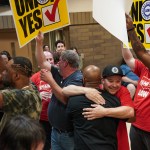
Convention Chaos Theory
Now that an extended Democratic nomination contest appears almost certain, there's been an explosion of renewed interest in the "brokered convention" scenario, which really just means a nomination that's in doubt after the primaries and caucuses are over. The big topics (explored especially well at OpenLeft.com) have been the battle over the 796 superdelegates, who are not bound by election results, and the possibility of a pre-convention or convention credentials fight over the Michigan and Florida delegations, who currently have no seats (or even hotel rooms) in Denver.
There's a more mundane but still significant problem with the situation: who will plan and execute the convention itself in the absence of a putative nominee?
National political conventions, despite the increasingly meagre live network television exposure they secure, are large, complex operations. Much of the initial preparation--fundraising, logistics, and site development--are done many months in advance, by local committees working with national party committees. But when it comes to the really crucial functions of a convention, such as who will speak when, what they will say, and how the whole show is presented to television viewers and to a massive international news media presence: every decision, major or minor, has in recent years been made with totalitarian authority by the putative nominee's staff.
As it happens, I've been a small cog in the machine during the last five Democratic Conventions, working in the script and speechwriting shops. To a large extent, convention operations are run by a floating circus of people, most of whom have been doing this as long as or longer than I have, who have regular day jobs and report for convention duty every four years. While the nominee's staff don't necessarily involve themselves in every minute detail, they have total veto power over everything that happens at a convention, and usually do micromanage the schedule, the speakers' list, and most of all the message. In 2004, for example, the Kerry-Edwards campaign set up a two-tiered vetting system for every speech (the second tier, where I worked, controlled what went on the teleprompter), and imposed strict message discipline on even the least important afternoon two-minute address (Al Sharpton was the one speaker who defied both the schedule and the message rules, with electrifying effect). All media communications were coordinated by the nominee's staff as well. And while much of this "controlling" activity happened at the convention itself, or in the week before it, the systems obviously had to be set up much earlier.
So: who's going to make all these decisions, and set up these systems, if the nominee isn't known until right before the convention, or until the convention itself? In theory, the DNC would step in, but keep in mind that every single DNC member is also a super-delegate and thus an actual or potential candidate partisan. And it's not as though there's any sort of generic schedule or message that can be planned that might not compromise one candidate or another, or the party as a whole
It gets worse: the last really serious platform fight at a Democratic Convention was in 1968. Indeed, the platform committee presentation is typically made to an empty convention hall in the middle of the day, and begins with a motion to dispense reading of the document, perhaps fluffed up by a short thematic speech. If the nomination contest is still in any doubt, platform fights might very well serve as maneuvers by one or both of the candidates to pry lose delegates, none of whom, BTW, will be bound by convention rules to stay with their pledged candidate (most of the non-superdelegates will have been chosen carefully by campaigns, and some may be bound by state laws and party rules). Who even remembers how to manage a platform fight? Who will plan the timing and structure? Nobody knows.
Moreover, in an open convention, every single speaker could represent a time bomb. In the recent past, speakers methodically echoed the convention message set by the putative nominee, and concluded every speech with a ritualistic invocation of the names on the ticket. What if many or most of the speeches tout one candidate over another? Will there be fights over the candidate preference of every politician seeking to get on the schedule? Will delegates and guests get into cheering contests after every speech? Nobody knows that, either.
Maybe, perhaps even probably, none of this chaos will ensue; with only two viable candidates for president, the odds of an open or "brokered" convention remain quite low, and really depend on so close a race that superdelegates or disputed delegations hold the balance of power. And perhaps the excitement associated with a truly deliberative convention outweighs all the concerns I've mentioned.
But it is time for Democrats to start thinking about these decisions, lest the convention devolve from excitement to a big, confusing, and divisive waste of precious time.


Neither Hil nor Obama lockup the nomination. Deadlocked 1st vote. Al Gore nominated from the floor. (the crowd goes wild).
February 5, 2008 5:43 PM | Reply | Permalink
"Neither Hil nor Obama lockup the nomination. Deadlocked 1st vote. Al Gore nominated from the floor. (the crowd goes wild)."
Me too, but I always wake up at the end. Reality; what a drag.
February 5, 2008 6:41 PM | Reply | Permalink
"Al Gore nominated from the floor. (the crowd goes wild)."
Well, *half* the crowd (Obama's people) maybe. The Clinton people go ballistic, and things get really nasty.
February 6, 2008 2:31 PM | Reply | Permalink
"Moreover, in an open convention, every single speaker could represent a time bomb. In the recent past, speakers methodically echoed the convention message set by the putative nominee, and concluded every speech with a ritualistic invocation of the names on the ticket. What if many or most of the speeches tout one candidate over another? Will there be fights over the candidate preference of every politician seeking to get on the schedule? Will delegates and guests get into cheering contests after every speech? Nobody knows that, either."
Sounds like fun. We should do it more often.
February 5, 2008 5:46 PM | Reply | Permalink
What's the character stand for?
February 6, 2008 1:07 PM | Reply | Permalink
gotta love the typo in "speechwriting" :D
February 5, 2008 5:46 PM | Reply | Permalink
I suggest re-doing Michigan and Florida AFTER the primaries are over. Then they'd both get their egos stroked because they'd be REALLY FUCKING IMPORTANT at the end and you could skip the delegate seating fights.
Also, it's kind of scary how close this is turning out to Eagle: The Making of an Asian-American President. It's a what-if Manga where an Asian-American Senator from NY takes on the sitting VP "Al Noah" in the primaries, tricks "Bill and Ellery" into supporting him, and goes on to battle a John Glenn/McCain republican in the general election of 2000.
Read it!
February 5, 2008 5:50 PM | Reply | Permalink
I say necessity is the mother of invention. WHo even watches conventions any more???
February 5, 2008 5:52 PM | Reply | Permalink
I hope that every democrat involved remembers that the objective is to dislodge the unitary executive, anti-habeas corpus, might makes right, piss on Congress, neo-Wilsonian, crony capitalist, corporate welfare, Constitution violating crew which has ruled for most of the last thirty years.
February 5, 2008 5:58 PM | Reply | Permalink
I will come down on the side of avidly anticipating a REAL political Convention that will actually spark interest and debate - the only downside I see is that the potential exists to exacerbate the divide which exists between the Clinton and Obama supporters.
That is the only negative I see.
The positive side, on the other hand, are that the networks will actually cover the Convention, sparking interest and conversation, perhaps motivating people after listening to real speeches designed to grab the wavering delegate also introducing us to new politicians who may never have the chance to be seen by an audience such as this. Scripted speeches following a laid out theme may be the very reason why viewership and network interest went down.
Let the Executive Board of the DNC run this type of a Convention - the plus side is that it could be riveting television - the unknown seems to scare some - but if they are scared of a Convention such as what you and I have described then their candidate and their campaigns shouldn't be running for the office of POTUS.
February 5, 2008 6:10 PM | Reply | Permalink
"Who even remembers how to manage a platform fight?"
I guess that Ted Kennedy endorsement looks even bigger in this context.
February 5, 2008 6:10 PM | Reply | Permalink
Hey, "speechwriting" and "speechtyping" are two different skills.
Thanks for the catch, though.
Ed Kilgore
February 5, 2008 6:34 PM | Reply | Permalink
Ed, lots of people know how to run contested conventions, because we do it all the time in State Conventions. Most or all of these follow the formal rules of the DNC. And 1968 is not the last time we had a floor fight -- we had a very significant credentials fight in 1972 about the Illinois and California delegations, the root of which was acceptance of the McGovern-Fraser Party Rules Changes. You will notice that the rules changes took -- the proportional representation so on view today was the intent of those new rules.
If it shapes up as a contested convention, you will find lots of attention paid to the membership of the Convention Committees, Rules, Platform and Credentials -- State delegations will select experienced people for these committees, precisely because they will be doing real work this time. Likewise a good many state delegates to the DNC have chaired state convention committees over time, and they will assume leadership to make things work. For while DNC members may have a candidate preference, they are also interested in a healthy convention that benefits the party. I suspect getting to a good decision, and leaving the convention ready for the General Election will motivate them to assure that process.
February 5, 2008 6:36 PM | Reply | Permalink
Good one!
If I remember correctly, the Carter people caved to Teddy's platform amendments in 1980, even though some of them flatly contradicted Carter administration policies.
But the big Teddy gambit was a rules fight over party rules that bound pledged delegated for one ballot. The challenge lost, but the rules were later repealed, which helps make things interesting this year.
Ed Kilgore
February 5, 2008 6:38 PM | Reply | Permalink
Ha ha... a Democratic operative is upset because the Democratic Party might find itself holding a convention in which a small measure of democratic to and fro took place.
That's rich.
You know, in a sane world a convention, particularly a Democratic Party convention would be an exercise in intraparty DEMOCRACY, don't you think?
This post is a beautiful illustration of the corporatization and complete political bankruptcy of the Democratic Party. It says that to compete against the Republicans (real fascists), we have to be just as fascistic and totalitarian as they are. God forbid that someone should give an unscripted speech!
You know the American people probably do have an abhorrence of democracy and disorder. Maybe a messy chaotic convention that produced a leader with broad political support would help to cure them of it.
(Or maybe it would just reinforce their fear of disorder and their love of totalitarian fascistic Republicans?) I think that if you have any optimism about democracy itself you can't fear an open convention battle.
This post and this fear of unscripted democracy and chaotic struggles for power speaks volumes.
I'm impressed.
February 5, 2008 6:46 PM | Reply | Permalink
These comments don't seem to be threading, so I'll address responses by name:
Sara:
Maybe I mislabeled the title, but I'm not suggesting that the party wouldn't find a way to muddle through and get the convention done. My point is simply that the deliberative nature of conventions gave way a long time ago to a tightly controlled and stage-managed media event designed to set the tone of the general election campaign and perhaps move the polls a few points (hence the post-convention "bounce"). If we're going back to a different purpose, that's fine with me (and I agree with everyone here who says it would be a lot more fun, would get more attention, and perhaps might even convey the sense of a more democratic "Democratic" Party).
But remember that the old pre-wired conventions had their down sides, like the spectacle of cops slugging delegates ('68), an acceptance speech being delivered at three in the morning ('72), and an entire convention revolving around the palpable unhappiness of the party with its nominee ('80).
We just need to think about how the deal will go down; that's all I'm suggesting.
Ed Kilgore
February 5, 2008 6:51 PM | Reply | Permalink
Mike2:
Do I seem upset about an uncontrolled convention? I don't feel upset. I agree with much of what you've said, and far from being an "order" freak, I fall into the Barack Obama "messy desk" category.
All I'm saying is that it might be a pretty good idea to look ahead and figure out how this would work. Conventions are not, after all, ends in themselves. We have an election to win.
Ed Kilgore
February 5, 2008 6:56 PM | Reply | Permalink
By the way, we already have rules for dealing with the Florida and Michigan delegations status, and those rules are in the National Call.
The decision to strip FL and MI of their delegates was made by the DNC at the recommendation of the Rules Commission, which deals with party rules between conventions. But that ruling can be appealed, and for that you take it to the Rules or Credentials Committee of the Convention, which is created once the state delegations are finalized. Each state has two delegate slots on each committee, one M, one F, and DC, the territories and Americans Abroad get one slot. Since the state delegates appoint these members, they end up representing which ever candidate has numerical control of a state delegation.
FL and MI will file a challenge to the rule of the DNC -- there will be a hearing, and the committee will create a majority report on the matter. If 25% disagree with the Majority, they file a minority report, and the matter goes to the convention floor, with the minority report debated first. FL and MI will not be able to vote on the issue. The decision of the convention is final, and cannot be appealed.
There is another means of getting to the floor -- by petition. This requires if I remember rightly, a petition signed by 40% of the seated delegates. This allows for circumventing the committee hearing process, and going directly to the floor. Again, a vote by the convention is final.
February 5, 2008 6:58 PM | Reply | Permalink
Mike2:
Do I seem upset about an uncontrolled convention? I don't feel upset. I agree with much of what you've said, and far from being an "order" freak, I fall into the Barack Obama "messy desk" category.
All I'm saying is that it might be a pretty good idea to look ahead and figure out how this would work. Conventions are not, after all, ends in themselves. We have an election to win.
Ed Kilgore
February 5, 2008 6:59 PM | Reply | Permalink
I find it a little weird and disturbing that so many are enthusing over the prospect of a few select individuals choosing the Democratic candidate. The prospect of the drama might be fun but do you really want the choice to be made by backroom dealers? Isn't that what happened in Florida in 2000? Is that what you want our party to become?
February 5, 2008 7:57 PM | Reply | Permalink
"My point is simply that the deliberative nature of conventions gave way a long time ago to a tightly controlled and stage-managed media event designed to set the tone of the general election campaign"
And piss poor job they have done of it, too. Most recent conventions of both parties have been about as interesting as a 72 hour Oprah special on paint drying techniques. That is unfortunate, but the real blunder lies in not taking the fight to the opposition. The 2004 Convention seemed to use robotic mind-control to keep speakers from attacking W when they should have been eviscerating him every hour on the hour. If that is what control is to used for, I for one want none of it.
February 5, 2008 8:11 PM | Reply | Permalink
Super delegates will need to be trusted to act "in good faith" at the convention, for the good of the country, and in the spirit of primary voters' decisions. Is that naive?
February 5, 2008 9:22 PM | Reply | Permalink
Ed Kilgore! Where have you been? I've missed you. I loved that I could always disagree with you and get a kind word in response.
Here's where I am on this issue, though... if the Democrats nominate some one at the convention who doesn't have a clear popular vote mandate, then I'm out. I won't be part of any party that regresses to back room politics.
What's funny is, I have no idea who the party would pick if they didn't have to deal with us pesky voters... They might well nominate my candidate. But the popular vote should be the guiding light here.
February 5, 2008 10:13 PM | Reply | Permalink
Ed,
This is a little disingenuous. It was definitely not all you (seemed to be/were) saying:
"All I'm saying is that it might be a pretty good idea to look ahead and figure out how this would work. Conventions are not, after all, ends in themselves. We have an election to win."
These are all statements designed to elicit horror at the thought of them:
"Moreover, in an open convention, every single speaker could represent a time bomb. In the recent past, speakers methodically echoed the convention message set by the putative nominee, and concluded every speech with a ritualistic invocation of the names on the ticket. What if many or most of the speeches tout one candidate over another? Will there be fights over the candidate preference of every politician seeking to get on the schedule? Will delegates and guests get into cheering contests after every speech? Nobody knows that, either."
What if all that happens? What if the democratic election process is followed by more democracy at the convention? You are obviously horrified at the thought, as are some posters above. I am not. And I think being horrified at the thought of a disorderly convention is symptomatic of the corporate fascist mindset that dominates the Republican party and pretty much dominates mainstream Democratic party thinking.
Yes, there is an election to win, and who is to say that an open contested Democratic part convention isn't the best way win that election by demonstrating that the Democratic party practices messy open democracy?
February 6, 2008 12:36 PM | Reply | Permalink
To Sara:
Actually, that's a pretty scary set of possibilities. My understanding of what you said is that either a majority of the Credentials Committee or 40% of seated delegates can bring the question to the floor; then whether or not MI & FL are seated is up to a majority of all the delegates.
So this scenario is possible: imagine a set of pledged delegates with a slight majority pledged to Obama. At least 40% of the delegates are pledged to Clinton and they vote to bring it to the floor. Then all the delegates, including the super delegates, I assume, vote on it. It's possible that even if Clinton lost in the delegate count she could win under this scenario.
Now I don't hate Clinton -- in fact I like her. But if something like that happened, the outrage would split the Dems into fragments and we could lose the GE.
I think someone in the Dem Party hierarchy needs to start thinking of a way to handle this issue that will be as fair as possible and unlikely to cause great fury. Hmmm -- pretty impossible task, I'm afraid.
February 6, 2008 1:19 PM | Reply | Permalink
I realize this post has attracted a relatively low number of comments. But I suspect they reflect a pretty strong, and contradictory, sentiment favoring an open convention so long as it's not just a playground for superdelegates who are ignoring the popular vote results. Unfortunately, that's the only kind of open convention we're likely to get, this year at least.
After all, the recent trend towards stage-managed, "undemocratic" conventions was the direct result of rules changes that made "democratic" delegate-selection methods supreme. I don't know how you could ever get a "spontaneous" convention whose results aren't known in advance without reducing the role of actual voters in the nomination process.
So choose your poison: boring, contrived conventions, or however you cut it, some sort of "back-room deals." We could abandon conventions altogether as anachronisms (an idea that gets discussed and rejected every four years). But I don't think you can have it both ways.
Thanks to everyone who commented.
Ed Kilgore
February 6, 2008 4:30 PM | Reply | Permalink
The reporters are obviously having fun today, reporting on how Hillary Clinton has **ALREADY** had to dip $5 million into her pockets to fund her campaign through Super Tuesday, and now seems on the verge of having to spend even more of their money to keep in the race.
And yes, the media will have a little chuckle about it, because they know how the Clintons earned a lot of that money.
Well, that and insider trading on cattle futures. The Clintons made their first millions based on what was essentially a bribe scheme. The overall investment technique was akin to baiting a four-year-old's fishing pole for them, watching over it, and then letting them reel in a big fish on one of your own lines.
Payback is a bitch sometimes, isn't it? Perhaps they should pull Bill off the campaign trail and put him back on the lecture tour...
That's alright though... Hillary Clinton knows that if the voters actually do give her the nomination, she can always keep raising money for her campaign, turning to corporate lobbyist friends in order to pay back her millions in loans to her campaign.
(i.e. She'll take bribes to directly pay off her personal debts, prior to taking office.)
So... why didn't she want to tell us about her self-funding before the race? Why did her campaign take so long in comparison to Obama's to report their income for January, only doing so after being repeatedly pressured by the press? Perhaps they didn't want to be known as the astroturf campaign?
February 6, 2008 5:17 PM | Reply | Permalink








